Step 1: Analysis of the sound spectrum
If you want to make your own sound bars for a vibraphone, they should sound like a vibraphone and not like something else. Therefore, the first step is to analyze the sound of good-sounding vibraphone sound bars.
Furthermore, the aim of the analysis is to determine the influence of the sound bars alone, i.e., without the influence of the resonance tubes.
In the first step, we therefore attempted to determine the sound target for our bars. To do this, we measured the sound spectrum of several sets of sound bars available to us using Fast Fourier Transformation (FFT). These were:
- Musser M55 Gold
- Musser M55 Silver
- ROSS Concert R715 Silver
We analyzed every bar in every set, as shown in the video, and noted the results. Suitable FFT software is even available as freeware for cell phones (spectroid, phyphox, etc.), and it's not bad at all.
With simple freeware programs, it is advisable to determine the overtones individually, as shown in the accompanying video.
However, we used a more accurate but more complex program from the university. With this program, we can also simultaneously record the amplitude spectrum of the frequencies in relation to each other in a single recording.
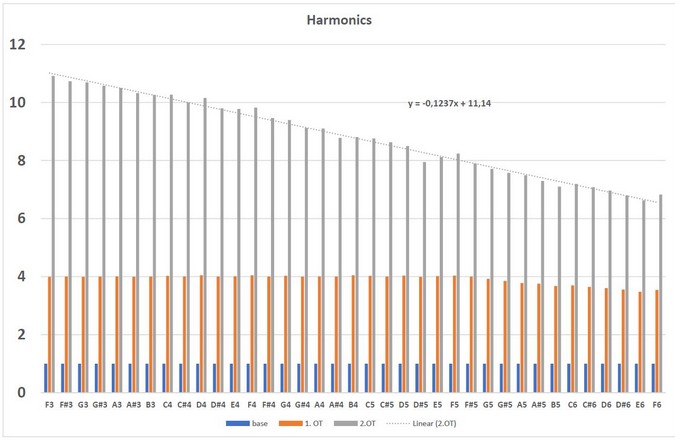
The result can be illustrated graphically using the example of a set of plates:
In the example set of bars, the first harmonic overtone remains at four times the fundamental tone up to F5 and then decreases linearly to 3.5 times the fundamental tone in the highest octave.
The second harmonic overtone decreases continuously from 11 times the fundamental tone to approximately 6.5 times.
We have set this sound spectrum as our goal for our bar set.